
Forged Pipe Fittings
– Forged Pipe Fittings for High-Pressure Piping Systems
Wellgrow supplies threaded and socket-weld forged pipe fittings for compact piping connections used in oil and gas, chemical processing, power generation, boiler, heat-exchanger, and pressure-vessel applications.
The range includes Class 2000, 3000, 6000, and 9000 fittings in carbon steel, stainless steel, and alloy steel. When correctly specified, installed, joined, and inspected, forged fittings provide high-integrity connections for demanding pressure-piping service.
Forging works the metal into shape and can produce directional grain flow and a sound structure when the material, forging reduction, heat treatment, machining, and inspection are properly controlled. Final product performance depends on the specified material, dimensions, service conditions, applicable piping code, and installation quality.
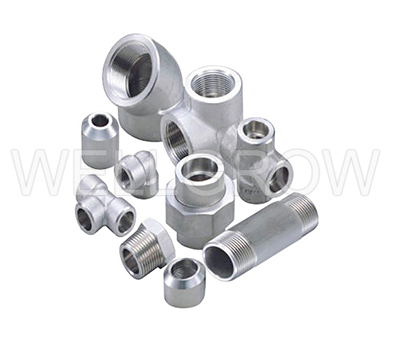
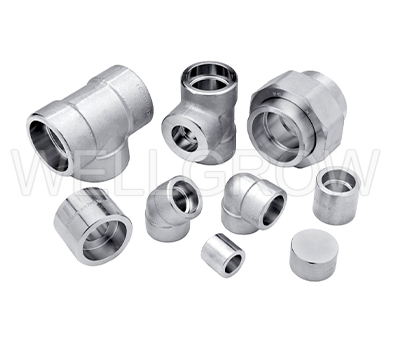
Forged Pipe Fitting Types
Wellgrow’s forged fitting range includes:
- Forged elbows: 45-degree elbows, 90-degree elbows, and street elbows
- Forged tees and crosses: Equal tees, reducing tees, and crosses
- Couplings and Couplets: Full couplings, half couplings, reducing couplings, Couplet Threaded, and Couplet Socket Weld for secure pipe jointing
- Plugs and Caps: Hex-head plugs, square-head plugs, round-head plugs, and pipe caps for line termination
- Unions, Inserts, and Bosses: Components used to connect two pipes or pipe fittings
- Nipples: Hex nipples, pipe nipples, and concentric and eccentric swage nipples
- Forged branch outlets: Threaded 90-degree branch outlets, threaded 45-degree branch outlets, socket-weld 90-degree branch outlets, socket-weld 45-degree branch outlets, butt-weld 90-degree branch outlets, and butt-weld 45-degree branch outlets
Forged Pipe Fitting Specifications
The following table summarizes the stated product range. Availability may vary by fitting type, material grade, size, Class, end connection, and applicable standard. Confirm the required combination during quotation.
| Specification | Stated range |
| Size | 1/8 to 4 in. (DN 6 to DN 100) |
| Threaded fitting classes | Class 2000, 3000, and 6000 |
| Socket-weld fitting classes | Class 3000, 6000, and 9000 |
| End connections | Socket weld; threaded NPT, BSPT, and BSPP |
| Carbon steel | ASTM A105 / A105N, ASTM A350 LF2, ASTM A106, and ASTM A234 WPB |
| Stainless and duplex stainless steel | ASTM A182 F304 / F304L / F316 / F316L / F304H / F316H / F317L / F321 / F44 / F51 / F53 / F60, ASTM A312, and ASTM A403 |
| Alloy steel | ASTM A182 F5 / F9 / F11 / F22 / F91 |
| Surface treatments | Anti-rust oil, phosphate coating, hot-dip galvanizing, and electro-galvanizing, subject to material and product suitability |
Product Standards
The applicable standard depends on the fitting type and the purchaser’s specification.
| Standard | Typical product scope on this page |
| ASME B16.11 | Forged socket-welding and threaded fittings |
| MSS SP-79 | Socket-welding reducer inserts |
| MSS SP-83 | Threaded and socket-welding pipe unions |
| MSS SP-95 | Swage nipples and bull plugs |
| MSS SP-97 | Integrally reinforced forged branch outlet fittings |
| BS 3799 | Hex nipples and bosses |
| ASTM A733 | Pipe nipples |
Products may be manufactured to the applicable standard and edition specified in the purchase order. Not every standard applies to every fitting type.
How to Select Forged Pipe Fittings
Threaded vs. Socket-Weld Connections
| Selection point | Threaded fittings | Socket-weld fittings |
| Joint method | Mating pipe threads assembled to the specified thread standard | Fillet-welded connection between pipe and socket |
| Installation | No field welding at the fitting joint | Requires qualified welding and inspection appropriate to the piping code |
| Common use | Compact small-bore systems where threaded joints are permitted | Small-bore systems where a welded joint is specified |
| Items to specify | Thread form, male/female end, Class, and material | Socket-weld end, Class, material, pipe wall, and weld procedure requirements |
NPT, BSPT, and BSPP are not interchangeable designations. State the required thread standard and designation in the RFQ.
Five Factors to Include in Your Specification
- Fitting type and applicable standard: Identify the elbow, tee, coupling, union, nipple, branch outlet, or other fitting and its governing product standard.
- Size and configuration: State all required dimensions. For reducing fittings and branch outlets, specify both run and outlet sizes.
- Class and connecting pipe: State the fitting Class and the connecting pipe size and wall or schedule. Class is not a standalone working-pressure value.
- Material and service conditions: Specify the ASTM grade together with design pressure, design temperature, fluid, corrosion allowance, and any low-temperature or corrosion-service requirements.
- Inspection and documentation: Identify the required MTC, traceability, dimensional reports, third-party inspection, marking, and packing requirements in the purchase order.
Final selection should be verified against the governing piping code and project specification. If a requested combination is outside the standard product range, availability is subject to technical review.
Quality, Inspection, and Documentation
Dimensional accuracy, material identity, thread quality, socket dimensions, marking, and traceability should be controlled according to the applicable product standard and purchase order.
An EN 10204 3.1 material certificate is provided with each shipment. The required certificate type, issuing party, traceability level, and certificate contents should be agreed during order review. Nondestructive examination results are included only when required by the applicable specification, inspection plan, or purchase order.
Depending on the product and order requirements, inspection may include:
- Visual and dimensional inspection
- Thread gauging to the specified thread standard
- Material identification and heat or lot traceability
- Third-party inspection or witness points, subject to prior arrangement
Inspection methods, sampling, acceptance criteria, reporting, and third-party involvement should be defined in the RFQ or purchase order. Availability remains subject to technical review.
Industrial Applications
Forged pipe fittings are commonly specified for compact high-pressure piping connections in:
- Oil and gas refining and petrochemical plants
- Power-generation and boiler systems
- Heat exchangers and pressure vessels
- Marine piping
Aerospace, defense, or other regulated applications require separate confirmation of the applicable material, qualification, inspection, documentation, and approval requirements.
RFQ Checklist for Forged Pipe Fittings
For an accurate quotation and technical review, include:
- Fitting type
- Product standard
- Size; run and outlet sizes where applicable
- Threaded or socket-weld end connection
- Thread standard and designation for threaded fittings
- Class and connecting pipe schedule or wall thickness
- Material specification, grade, and any supplementary requirements
- Quantity for each line item
- Surface treatment or coating
- Required inspection, NDE, and acceptance criteria
- MTC, CoC, traceability, dimensional report, or third-party inspection requirements
- Marking, packaging, and delivery requirements
- Drawing or datasheet for non-standard items
Frequently Asked Questions
What is the difference between Class 3000 and Class 6000 forged fittings?
Class 6000 fittings generally have heavier pressure-containing dimensions than comparable Class 3000 fittings. ASME B16.11 uses pipe wall assumptions as part of the rating basis; Schedule 80 / XS and Schedule 160 / XXS are often referenced during preliminary selection. However, Class is not a fixed working-pressure value, and a schedule pairing alone does not complete the selection. Verify the material, size, design temperature, pipe wall, fitting type, and governing piping code.
Are threaded and socket-weld forged fittings interchangeable?
No. They use different joint designs, installation procedures, and Class ranges. The permitted joint type must be confirmed against the project specification and piping code.
Do you provide Mill Test Certificates for forged pipe fittings?
Yes. An EN 10204 3.1 material certificate is provided with each shipment. Confirm the required certificate type, issuing party, traceability level, and required test results in the purchase order. NDE reports should be requested separately when required.
Can Wellgrow supply NPT, BSPT, and BSPP threads?
The stated range includes NPT, BSPT, and BSPP. Please specify the thread standard, designation, and male or female end. Availability varies by product, size, Class, and material.
Can Wellgrow manufacture forged fittings from customer drawings?
Non-standard forged components and customer drawings may be reviewed upon request. Feasibility, material, dimensions, tooling, testing, marking, quantity, and delivery are subject to technical and commercial review before acceptance.
Request a Quote
Send Wellgrow your fitting list, applicable standards, sizes, Classes, materials, end connections, quantities, design conditions, inspection documents, and delivery requirements. The team will review the requested combinations and provide a quotation based on the confirmed technical scope.